Saturday - September 19th, 2020 - From our poetry archives: Julia Knobloch - “Industry City” - Issue No. 6 - Winter 2018-19
There are dozens of reasons to love Julia Knobloch’s prose poem, “Industry City,” which appeared in Issue No. 6 - Winter 2018-19, here’s one: reading Knobloch’s stacked lines and rhythmic and repeating cadences allows you to ride along as she travels by bike, an over priced vintage Peugeot, across the Manhattan Bridge, from Brooklyn to north Manhattan (Inwood), down and across the East Village, and then back into Brooklyn once more.
Even before “Industry City” brings an intimate “you” into the world that the poem creates, it imbues its protagonist, the bicycle itself, with a personality and spiritual significance that surpass the antagonist “you.” The fact that the bike was, and will likely continue to be, a powerful and living force is made clear from the poem’s first beat: “I took my bike to die in Industry City today.”
After reading Knobloch’s poem, you get the feeling that even though she left the bicycle “leaning against a scaffolding at 2nd Avenue and 35th Street,” the vintage Peugeot, as well as Knobloch, still think of each other, and perhaps even, quite fondly.
- Portrait by Adrian Moens
___________________________________________________________________________________________

I took my bike to die in Industry City today. It was the first bike I bought in New York, I bought it used in the East Village, an overpriced vintage Peugeot frame. Over the years I spent more than 1000 dollars to maintain it because soon after I bought it, it needed repairs and kept needing them. Now I had let it sit in the yard for too long, the tires first flat then porous, the rubber grips viscous, the saddle fissured, the chain rusted, snow falling and melting on it, a nuisance in disrepair to my neighbors and landlords. The bike took me all over Manhattan in those first years, to Inwood along the river, through giddy summer nights on the Lower East Side, winter storms on Columbus Circle, up 1st Avenue, where I was doored twice, once by a police officer who begged me not to report him but then didn’t call in the evening to hear how I was doing. The job on 1st Avenue was the first of three jobs where I was bullied, my old pre-immigration self is still confused why this kept happening. The bike took me from Manhattan to Brooklyn when I moved there for more space and less rent before everyone, including you, was moving back in the other direction. I loved the bike like other people love their pets, like I had loved my car -- a Renault, come to think of it -- my companion who waited for me at whatever lamppost I left it. In the picture I took of it in the middle of the Manhattan Bridge I can almost see it smile. There is something about bike rides, these moments out of time, a common theme in movies, you know, you studied these things, narrative. Sometimes I imagined how we would ride together along the bay down to Coney Island, I owned two functioning bikes for a while, and when you said you didn’t know how to ride a bike, I thought how fun it would be to show you how, I imagined how you would laugh like I imagined what you would look like when you swim. I don’t know if you know how to swim but there are several reasons why I think you know, one being that parents are commanded to teach their children how to swim, and even though you said that your dad thanked G-d for no longer being responsible for you when you turned thirteen, I’m sure your parents made sure that you wouldn’t drown. We never rode together along the bay down to Coney Island, and the bike started rusting away, everything, the basket, the bell, the frame, not just the chain, and I was unable to do anything against it or with it or about it. I was incapable of leaving it at a random corner or putting it out on a Monday or Thursday night and waking up hearing the garbage truck, but finally today, a few days before the summer solstice and just hours before flying to Europe for my father’s birthday, I took it to Industry City, after all it is a Peugeot bike, and maybe Industry City is where hipster bikes, even in a state of despair, want to go when they die. Frankly I also chose Industry City because it reminds me of you, it reminds me of the 1970s movie we saw together, the one with the car chase through quite different looking blocks between 3rd Avenue, and 2nd Avenue, and the piers. I forget the name of the movie but it was one of our better movie nights, not as good as the one when we saw the preview of that Victorian horror drama, I don’t think it ever made it to the real screen, an abandoned work of unsuccessful narrative, but the memory of the complicity of that night still brings me pleasure, and I wish it does to you, too, although I don’t know if you remember; then again, knowing you, I believe you remember everything, definitely the names of movies. Industry City is also the place where we had one of our first bad nights, in that gallery I assume you’re still frequenting because you always seemed more into art than into poetry. You had begun dragging me to readings in art galleries but ignored me once we got there, flirting with women whom you called friends, potential clients, saying that if I couldn’t bear to watch you network why did I come with you in the first place and in fact, why didn’t I just leave, I clearly wasn’t enjoying myself, you wouldn’t be too long, and I walked the few blocks back home, convincing myself I was giving you space. You came hours later, your hair smelling of bonfire and alien fragrances, your breath of liquor. It was time to let you go but I think I mentioned that I was doored twice and bullied three times; I think there is a connection between these things, and then you left, and I watched the snow fall and melt on the bike for almost two years until today. At first, I imagined leaving the bike at the entrance to that gallery, but then I didn’t remember what side street and what warehouse entrance, and I didn’t want to look up the address for a piece of performance art that only I would see. I left the bike leaning against a scaffolding on 2nd Avenue and 35th Street, I padded the saddle and said thank you for your kindness in the extraction of this, wishing you well, happy strong sun strawberry moon solstice and walked away past the coffee lab, the wine store, and the pickle shack, in the ever-increasing June light.
Friday - September 18, 2020 - Manhattan Greenery: St. Luke’s in the Fields - 485 Hudson. by Jordan Myers
Along Hudson, just north of Barrow Street, there’s a garden beside St. Luke’s Church; where you can find a place to sit, read, and think. There’s no prayer required. It’s only as holy as you want it to be.
Thursday, September 17, 2020 - On this day in New York history: 1927 - René Lacoste wins his second consecutive U.S. National Championships - Forest Hills, New York. by Jordan Myers

René Lacoste in 1922 - National Library of France.
Are you wearing a polo shirt, and does it have a crocodile on it? If so, René Lacoste, the Frenchman who was ranked No. 1 in the world in 1926 and 1927, and was inducted to the International Tennis Hall of Fame in 1976, would be proud.
Lacoste, who earned the nickname “the Crocodile” for his hard-charging and tenacious playing style, refused to compete in matches in full-on button-down long-sleeved dress shirts and slacks, and instead, insisted on playing in polo shirts.
Although he didn’t start playing tennis until he was fifteen-years-old; he went professional at seventeen, then only seven years later, retired from the game at twenty-four. In his brief and glorious seven year career, he not only changed the standard attire for gentlemen who were sprinting up and down and across and over tennis courts everywhere; but also, through the use of the crocodile mentality, he won –––– a lot, or said otherwise, he cleaned up: 262 wins and only 43 losses; 24 career titles; as well as a bronze metal in men’s doubles at the 1924 Olympic games, which took places in his home country of France.
Although the video isn’t available, all reputable accounts have established that this is what happened: on a mid-September afternoon or early evening, or perhaps, morning, the twenty-three-year-old Lacoste, more than likely donning a polo shirt, walked onto the main grass court of the Westside Tennis Club in Forest Hills, NY; shook hands (perhaps) across the net with his opponent, the American, Bill Tilden; then walked back to his end of the court and examined the strings of his wooden racket one last time before the matches’ first point.
Although Tilden (“Big Bill”) was a tennis titan, as he was ranked No. 1 in the world from 1920 through 1925, Lacoste had won the tournament the year before. When it was all over, from the best out of five sets, Lacoste had won in three straight: 11-9, 6-3, 11-9.
Six years later, after having wound down his tennis career, Lacoste would form the clothing brand which shares his surname and features the crocodile logo. Since 1971, Lacoste, the clothing brand, has been the official sponsor of the French Open, the annual Grand Slam at Rolland Garros.
Per the tournament’s official store: “Lacoste dresses the referees and linesmen of the French Grand Slam. This year, Lacoste is also dressing the ball boy’s outfits: polo shirt, sweatshirt, shorts, pants and cap will be adorned with the famous crocodile.”
This year, from the men’s section, the Rolland Garros store features twenty-eight varieties of t-shirts; twenty-one different polo shirts; twelve unique pullovers and sweatshirts; and nine Lacoste-designed jackets and blousons. No dress shirts are for sale.

Lacoste at Wimbledon in 1925; the first time he won England’s Grand Slam.
Wednesday, September 16, 2020 - Endless days. by Jordan Myers
Endless days having oatmeal
for lunch at 4:30pm. Endless
days listening to Blossom Dearie
& the Blue Stars’ The Pianist,
her jazz piano: quiet; her French /
luxurious. Endless days watching
summer sprint away for the year;
hail autumn, here’s the cue:
you’re up next. Endless days,
endless days, endless days.
Tuesday, September 15, 2020 - Ninth Avenue at dusk: Between West 57th and West 50th. by Jordan Myers
Walking down Ninth Avenue at dusk it’s possible to see something new every day. By something new I do not mean different people, or different objects, or different cars, or anything else that’s always changing along the avenue.
In particular, I’m referring to the portion of Ninth Avenue that’s a downslope, which descends from West 57th Street on a slight angle and does not level-off again until one reaches West 50th Street. The descent, oddly, is less noticeable while walking north, and on an incline, than it is while walking south.
This is most true at dusk. At dusk, if you time it just right, and if you pace your steps at a rate that’s just slow enough to be gradual, yet not so slow that they’re belabored, then you’ll notice the way the sun sets against the fire escapes that stand upon the facades of the brownstones, mixed-used buildings, and multi-family walk-ups that line the avenue.
If Ninth Avenue were a forest, then the buildings’ facades would be the branches of its trees, and the fires escapes would be the birds perched, almost without moving, upon these branches.
I’ve walked this stretch of Ninth Avenue maybe one hundred times, yet for the first time this evening, at dusk, I saw the way the sun, row-by-row, casts its light across the side of each building in the distance, all the way down the hill. I don’t know how I missed this -––– it felt like living inside of a painting -––––– but I just never saw it before.
Monday - September 14, 2020 - City facades: Hudson Street (Between Laight & Hubert). by Jordan Myers

- Matcha latte from Interlude followed by a walk up Hudson: Tribeca, Summer 2020.
Sunday, September 13, 2020 - Opening day - West 55th Street, between 8th Avenue and Broadway. by Jordan Myers
On a sleepy and cloudy Sunday morning along West Fifty-fifth Street just east of Eighth Avenue, four men and one woman gather: two of the men in black and almost matching New York Jets t-shirts, one in a white Miami Dolphins long-sleeve T (the sleeves pushed up onto his biceps), the fourth in a teamless black t-shirt with white horizontal stripes. The woman wears a Rob Gronkowski jersey —- New England (87). Gronk’s retired, so she says she has to buy a new one, soon. They’re in their late twenties or early thirties. Three Monkeys, on West Fifty-fourth, is suggested as a place to sit outside and watch the games. There’s talk of fantasy football: picking up players off of waivers and the different rules between leagues. No one’s in a hurry; they linger for a while ——- (almost noon) an hour till kickoff / they head west.
Saturday - September 12, 2020 - Jessica A. Krug’s resignation: “Don’t just talk about it, be about it.” by Jordan Myers
I’ll admit that when I heard about Jessica Krug’s resignation from her post as a Black-studies professor at George Washington University, I did so with delight. Krug, who last week revealed that she had been hiding the fact that she is white, had previously spent over three decades self-identifying as Black, Latina, or a combination of the two.
Although I’m still processing what Krug’s admission (if one can call it that) means to me, this much I know for sure: her revelation and subsequent resignation (the University would have removed her had she not resigned) signifies that personally and collectively, we’re being pushed to think more deeply about the meaning of our lives; the origins of our identify; as well as the intersections and parallel lines that create the space between these two. Myself, of course, included.
Her resignation suggests that we’ve reached a point in time where hiding behind whatever masks and veils that we’ve decided to put up around ourselves is becoming less and less possible. Personally and collectively, our false ways of living, moving through the world, and interacting with each other are being chipped away –––– bit by bit and moment by moment -––– so consistently and so forcefully that eventually, only our truths will be able to emerge.
I first heard of Krug while reading Lauren Michele Jackson’s masterful essay from The New Yorker, “The Layered Deceptions of Jessica Krug, The Black Studies Professor who Hid that she is White.”
While reading through Jackson’s essay, I clicked over to the now famous clip of Krug “giving the people what they want,” by way of speaking during a virtual New York City Council Hearing, which took place in June.
In the clip, Krug speaks of the need to not just defund, but instead, to abolish the NYPD. “They’re a colonial occupation force,” she says as she is, presumably, walking through “her neighborhood” the Bronx (she actually grew up in Kansas City, Missouri) and staring into the video feature on her phone, all the while donning neon-purple-shaded aviator sunglasses. “If this city is for ‘us,’” she says, “The NYPD can’t stay.”
As I watched (and now have re-watched) the clip, knowing that her accent and her demeanor were put-on and for show, I also wondered which of the words that she spoke she actually believed in.
Perhaps the delight that I felt, as a Black man, learning of this un-masking and resignation, relates with a strengthened resolve that my life, and by extension, life in general, is even more beautiful and complicated than what may appear.
Quite often throughout this summer of action, protest, awakening and civil unrest, one sentiment that was shared was the idea that silence signifies compliance with oppression. Now, this idea, through Krug, and also through those who have operated from this same place ––– as she’s not the only person who has ever attempted to pull of this type of race re-assignment ––– has proven fallible.
While engaging in her own form of oppression, Jessica A. Krug, was almost always saying and writing all the right words; yet, those words were always undercut, owing to the fact she was never fully-honest with herself.
If however, one is still desiring of a quick quote, pulled from a dense text or speech, which may or may not be taken out of context, this one –––– from a source unknown –––– may be of use: “Don’t just talk about it, be about it.”
Friday - September 11, 2020. by Jordan Myers
I was sitting in a high school classroom at Lawrence Central in Indianapolis my sophomore year and taking a standardized test, the ISTEP, when the twin towers fell. That’s not quite right. I was not taking the test the moment they fell. We were in between sections of the test and the boxy television that was hanging in the corner of the room opposite the doorway was switched on, and images of lower Manhattan were being piped into our classroom.
I can’t remember whether the sound was on, but if it was the words that the men and women on the news were saying didn’t matter. This was a moment beyond words. I remember one of the towers had a gaping hole in its side and my first thought was this: I wonder how long it will take to repair the building, to fix the blemish in the side of the tower. It didn’t cross my fourteen-year-old-mind that the whole thing might come down and collapse into a puff of smoke ––– but then it did, and then our instructor turned the television off.
Maybe we were sent to lunch early, or given time to call family –––– I can’t remember, but I doubt we picked up our pencils, went back into the ISTEP, and started filling in bubbles labeled (A) (B) (C) (D) or (E) again. At least not right away. The world had changed.
My dad is from Harlem and I knew he would have calls to make; and somehow I felt those calls pass down from him and fill my own consciousness: was everyone alright? It had been years since we had visited New York, but even as a teenager growing up in Indianapolis, I remember feeling this glow and energy from the city drawing me in, closer and closer every time I’d meet people from there, or hear stories about what it was like to live there. This went on for a decade, as it wasn’t until ten years later, 2011, when I actually moved here.
From a distance and perched upon the twentieth-floor balcony of my uncle’s apartment in Harlem, for the ten-year anniversary I could see One World Trade Center, still under construction, yet standing tall all the way downtown at the edge of Manhattan, a promise that anything that falls in New York can be built back again.
Although I stood out there for a while that morning, I didn’t have time to think of my fourteen-year-old self who was watching New York from a distance a decade before, without knowing that he’d actually live there in ten years’ time. I was twenty-four and had just taken the New York bar exam in July, and needed to find work –––– pronto. That was almost all that I could fit into my mind at the time: get a job; find work, find a way to stay here, and get your own place.
Thursday, September 10, 2020 - The Bob Woodward Tapes & The United States’ Shift from Duality to Unity. by Jordan Myers
There are failures that occur as the result of an oversight, from misinformation, or from a misunderstanding. There are moments when those who are responsible for leading the nation are unable to assess and comprehend facts. In these moments, one’s inability to form reasonable conclusions, and then speak and act accordingly may be overlooked; or even, pardoned.
All that can be asked is that the those who are elected to positions of leadership and authority in the federal and state governments try their best. There are occasions when determining whether a president is trying his best can be examined with objectivity. Under such circumstances, questions of morality and personal and political preference may be set aside.
If a president is trying his best, when he becomes aware of information that could endanger the lives of millions of people in the country over which he has been elected to serve, he does at least one of two things, if not both: (1) He informs the public of the information that he has become aware of; or (2) Even if he does not inform the public, he takes measures and steps to help assure that the public may be prepared for a pending crisis.
Here are the clips from the interviews with Bob Woodward, wherein on February 7th, 2020, the president of the United States of America mused, inter alia, that Covid-19 is “deadly stuff,” which “spreads through the air,” and is “more deadly than [a] strenuous flu.”
Armed with this information at least one month before the spread of the novel coronavirus claimed the attention of our city –––– leading to approximately twenty-thousand deaths, and thereafter and gradually, our country, the president did not try his best.
While it’s tempting to examine the shock value of these tapes, to do so would be missing the point. Shock and awe is what this president wants. He escalates. He does not de-escalate. He hypes up. He does not calm down.
Yet, one thing that has made 2020 a remarkable year, despite the sickness and loss of life from the outbreak of Covid-19, and despite the repeated murders of Black men and women at the hands of those who’ve been sworn to serve and protect them, is the opportunities for deeper reflection that have flooded the nation’s collective consciousness.
Not everyone has felt the shift, or taken advantage of the infiltration of deeper and more meaningful questions, along with the extended amount of time to consider them, but for those who have –––– and for those who are –––– the rewards have been, and will continue to be sweet.
Donald Trump is the old. His mannerisms, his speech patterns, his sayings, his deflections, his shiftings of blame, and his overall way of being in and of the world reflects the old guard’s creed: “If it benefits me and my friends, I’m in. And if it doesn’t, I’m out.” There’s one phrase for this way of being that expresses the shift that our nation is undergoing in a way that’s clear and direct: duality v. unity consciousness.
The presence of duality consciousness suggests that it’s possible for me to have an experience that is separate from yours: I am over here –––––– and you are over there. Whatever you are experiencing has no bearing on my experience, and vice-versa.
Part of the beauty of 2020 is that this year, and in this time, it’s possible to look back and realize that the United States has developed a more consistent history ––– and legacy ––– of unearthing duality consciousness than one might realize, at first blush. Duality consciousness was once “Separate but equal.” Duality consciousness was once “Whites only.” Duality consciousness was once dispossessing women of the right to vote.
And already, these outward-facing forms of racism and sexism have been eradicated. And what the nation is facing now is the same fight; however this time, it’s inward-facing. This time around, it’s neither the laws nor the books that this shift is changing; instead, it’s the nation’s own collective consciousness –––– from duality, to unity.
Wednesday - September 9, 2020 - Postcards from New York - So this is time moving forward. by Jordan Myers
I remember biking up Tenth Avenue in late May and thinking that time had stopped. Restaurants were still only open for takeout and delivery, so one was sitting down to a meal outside.
Back then, applause and cheers for essential workers were still being made every day at 7:00pm. And each evening, the sun would hold its place in the sky for longer and longer.
Yet tonight, I can feel the endlessness of the forever summer drawing to its close; and the feeling of infinite time to bike, run, and walk and wander around our sleeping city fading away.
Tuesday - September 8, 2020 - City facades: Greenwich Street (Between Charles & West 10th). by Jordan Myers


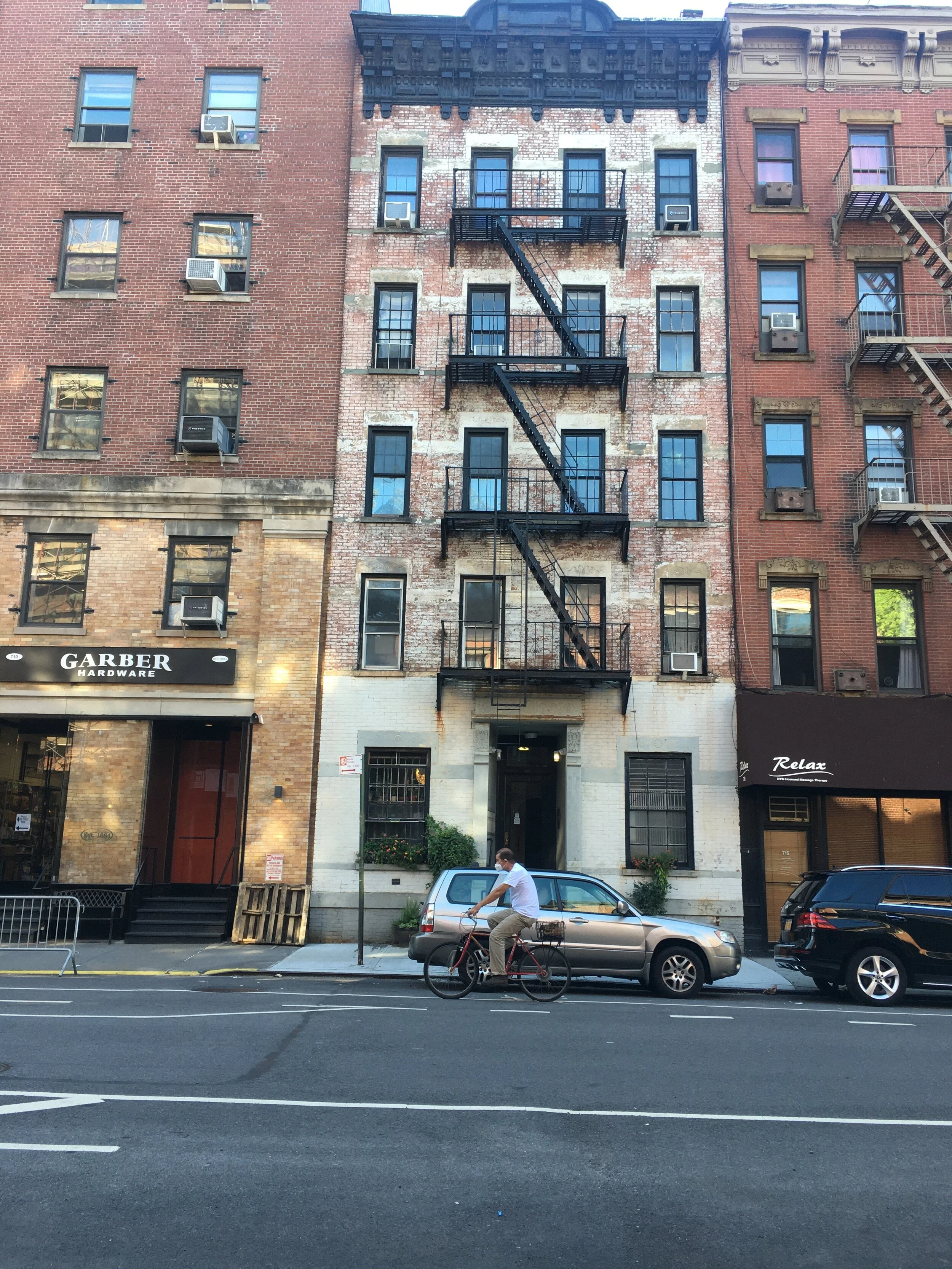
Around the corner from The Elk on Charles you can walk down Greenwich in the autumn with a cup of coffee or tea in-hand no problem.
Monday - September 7, 2020 - Washington Square Park: Labor Day. by Jordan Myers
Shirtless in jeans: shadow-boxing, sparring with the air.
In a white t-shirt with black shorts: on roller-blades,
whirling fast in circles. Blue ball-cap: pushing around
a steel-wired cart that carries The Urantia book. A Jazz
trombone; acrylic paintings; a drum-line beneath the arch,
the arch. Chalk drawings near the fountain, the fountain.
Sunday - September 6, 2020 - From our poetry archives: “Self Portrait as a Still Life” - Liz Adams - Issue No. 4 - Summer 2018.
Extending our look back at the work of the figurative painter, poet, and humanist, Liz Adams; we offer “Self Portrait as a Still Life,” the companion poem to “Linens,” which held the space for yesterday’s Daily.
As we inch closer and closer to autumn’s beginning, with the layers of all that’s already happened in 2020 still lingering in our hearts and minds, the entire city feels “flush with a whorl of nowness.”
- Photography by Emily Fishman
Self Portrait as a Still Life
I’ll be the robin’s-egg blue
pitcher in my mother’s pantry ––
Where I would search for silver
and linens on fine Sundays.
Or, given the choice, a pink peony
flush with a whorl of nowness.
I’ll speak to you boldly with my hues:
titanium white, quinacridone rose.
One hundred petals of a story ––
each ruffled and veined,
Leading to my egg-yolk
center of golden occasions.
Cup me in your hands, bury
your face in my perfumed core
Where the colors congregate
before fading at the edges.
Set me in the blue pitcher,
let the right light catch.


Saturday - September 5, 2020 - From our poetry archives: “Linens” - Liz Adams - Issue No. 4 - Summer 2018.
There’s a synergy that occurs often, though not always, when poetry and visual art meet. Not every painter who tries her hand at poetry has a knack for knowing what to show through words, and what to keep hidden within the spaces and lines that make up the poem.
Liz Adam’s poetry is focused and intentional, and does not try to do what her paintings have already accomplished. Over the summer of 2018, we enjoyed speaking with Liz, the self-described figurative painter, poet, and humanist.
Adams, who is a native of Marietta, GA received her BFA in Drawing and Painting at Georgia State University. From there, she later relocated to New York to continue her studies at the Art Students League and the National Academy School of Fine Arts, where she studied life drawing and painting.
Although the amount of time that she’s spent as a painter stretches farther back than her poetry practice (she first started writing poems in 2017), there’s a freshness, as well as an emotional honesty to her work that’s easy to pick up on.
“Linens,” offers a solid example: fabrics, napkins, and “sullied cotton with its / Perwinkle striped border” are brought to life, then imbued with colors that only a painter can see: “The color of sky, of possibility, of first love.”
- Photograph and portrait by Emily Fishman.
Linens
I have taken to stealing napkins at bars
Those French country accents
Very chic and understated
A wishful me
Dab at the corners of my mouth
Wipe away words
I didn’t mean to say
I’ll clean the sullied cotton with its
Periwinkle striped border
I’ll wash it by hand
Let it air dry
Pressed to a warm window
The way my grandmother showed me to
Wash a handkerchief
I carried hers
Down the aisle
With its goassamer lace
The color of sky, of possibility, of first love
Nothing lasts but her cloth of delicate grace
To wipe away the loss
I still have linens to wash
Squeezing out the water
Each time remembering her worn hand


Friday - September 4, 2020 - Postcards from New York - Traffic along Varick as well as Tenth Avenue - “[Horn honking] Drive Around!” by Jordan Myers
Traffic for the first time in a long time; not gridlocked, but a marker of what was. Two streets mainly: Varick at around four in the afternoon, heading south toward the Holland Tunnel; as well as Tenth Avenue, around six in the evening, heading north toward the Lincoln Tunnel.
At Varick and King: one man in a white t-shirt, sunglasses, and black leather gloves drives a burgundy Chevy Trailblazer and lays on his horn. He’s heading east on King and wants to cross Varick; yet, as the box is partially blocked by vehicles heading south on Varick, the driver of the car in front of him is hesitant, uncertain, and doesn’t know what to do.
The Trailblazer’s driver offers his advice; as in between two or three bouts of honking his horn, he cries out: “Drive around!” [horn honking] “Drive around!” [horn honking] “Drive around!” –––– his best impression of House of Pain.
Thursday - September 3, 2020 -Heard on West 48th Street (Between Eighth Avenue and Broadway). by Jordan Myers
Ext. / Day - West 48th - Sidewalk, one small table with two chairs beneath an umbrella, outside of La Masseria Caffe.
Tara, early twenties, thin, blonde, in light pink sweatpants, white throwback oversized sneakers (of the variety that have recently come back into fashion) and a black halter top.
Mom, via Facetime.
Tara:
I’m getting a tattoo.
Mom:
Of what?
Tara:
“Tara’s world.”
Mom:
Where?
Tara:
––– in my handwriting.
Mom:
––– Where on your body?
Tara:
I don’t know.
Mom:
I wish you wouldn’t.
Tara:
Thanks for making me not excited about this.
Mom:
I don’t see the point.
Tara:
My mind is made up.
The subject is changed.
Wednesday - September 2, 2020 - Black Fox Coffee Co. - Midtown East - 45 East 45th Street (Madison Avenue). by Jordan Myers
Within the Roosevelt Hotel, Midtown East, there exists a spot for espresso in the middle of a coffee desert. It’s a shop called The Black Fox and it’s open from Monday through Friday, from eight in the morning until four in the afternoon.
This morning I traversed east, through a cloudy and grey Manhattan. Crossing through the Diamond District, I found myself at Madison and East 47th, then noticed the Roosevelt Hotel two blocks south. These days rooms at the Roosevelt that once went for almost five hundred dollars a night can be booked for eighty-five.
Along Madison, men’s shops are abound: Men’s Warehouse; Charles Tyrwhitt; Sayki; My Suit; as well as the shoe’s store, Clark’s. They’re keeping their doors open, unabashedly afraid of being stood up by the thousands of men who once, not so long ago, walked up and down Madison Avenue each morning, afternoon, and night. The men who would pop in for a fitting, to buy a suit, to pick up a few ties over their lunch breaks, or who walked in, just to browse. The men who would get off the Metro North at Grand Central in the morning and walk over and into the giant office buildings that stand stories and stories high –––––– somewhere up there, there are views of The East River, Brooklyn, Queens, and the Bronx.
The retailers who are keeping their doors open, day after day, make their announcement: we’re trying, we believe in Midtown Manhattan, and are ready for the revival, even if no one knows how long it will take.
Outside of The Black Fox this morning, sat two sets of tables and chairs: wooden, quaint and inviting. As I walked in, two men and two women were having coffee and pastries together; their conversation, lively –––– a collective sign of life that was piercing through the veil of an abandoned and forgotten city.
Sunny days are better; there’s more life outside. But even through the grey and the light rain, there’s a feeling within this city: remnants of what was; preludes to all that will be; as well as a pulse, that no matter what, still beats.
Tuesday - September 1, 2020 - City Facades - 57th Street & Ninth Avenue. by Jordan Myers


882 Ninth Avenue in a muted meringue, standing strong beside and beneath the Henry Hudson Hotel (353 West 57th Street), formerly the Clubhouse of the American Woman's Association.
Monday - August 31, 2020 - Movie reviews for films that first screened a minute ago: John and Mary (1969). by Jordan Myers
It’s been a minute, but here is a film to watch on a Saturday morning or early afternoon; when a date, or a serendipitous romantic interlude has happened upon two people ––– something to put on once a Friday evening has spilled into the next morning, or also, once it has collapsed into the next afternoon: John and Mary (1969).
Directed by Peter Yates, the film begins in the dark. The scene is the bedroom of John’s apartment. John (Dustin Hoffman) is sleeping far more soundly than the woman who awakes, a bit a lost though not panicked, in the bed beside him, Mary (Mia Farrow).
At first glance, it’s a wonder that Yates, as well as John Mortimer, who wrote the script, were able to stretch this adaptation of Meryn Jones’ 1966 novel by the same name into a ninety-minute film.
The film moves a bit like a snowball, rolling down a hill, gathering momentum and collecting weight as it continues its descent. The momentum, in part, derives from the fact John and Mary, though already having slept together, know just enough about each other that they’re always wanting to know a bit more. A question begets an answer; which begets another question, which is followed by another answer, and then again, another question.
John and Mary, owing no less to the talent of Hoffman, as well as the deferring yet commanding nature of Farrow, was certainly ahead of its time. One review from the New York Times, from December of 1969, is indicative: “A familiar love story told backwards.” The ‘backwards,’ we’re meant to understand, refers to the fact that these two paramours share a bed and become intimate before going out on several dates and courting each other, rather than after.
Although the balance of the film accompanies John and Mary as they talk, cook, eat, and lounge around John’s modernistic apartment on Riverside Drive –––– he designs furniture, and it shows; consistent use of flashbacks, as well as jump-cuts to future projected possibilities broadens the film’s reach.
The most effective of these are the most immediate; particularly, the flashbacks that travel back less than twenty-four hours, when John and Mary met at a “singles bar” in Manhattan. It’s a crowed and bustling place, one in which John’s friend, Stanley (Stanley Beck) refers to as “A paradise for bachelors,” to which John counters, “The subway, with booze.” Notably, neither John nor Mary actually wanted to be there, yet they were pulled in, by friends.
These flashbacks and leaps forward have a purpose: even if John and Mary are okay with knowing very little about each other’s past, as we’re tuning in and dropping in on their lives for a while on this one Saturday afternoon; naturally, we’re a little curious.
Here’s the short of it; John has fears of abandonment; Mary has struggled to keep a high self-esteem; and they both have built up sizable fortresses around their hearts ––––– lest either one of them actually fall in love.